

Yotta 2025: Our Key Takeaways
Yotta 2025 brought together leaders from energy, data centers, hardware, and software. The central message was unmistakable: data centers are now critical infrastructure, and AI is accelerating demand at a pace unlike anything before. Analysts estimate $7 trillion will be invested in the next five years. Many compared this moment to the arrival of the steam engine — a turning point for how human work is organized and scaled.
1. Power Stole the Show
The defining bottleneck is no longer GPUs but electricity. Yotta 2025 often felt like a power conference. Attendees agreed that the only true competitive advantage today is speed to market. Not everyone will win, but those who act fast will be rewarded.
On-site cogeneration is emerging as the reality, from natural gas turbines to nuclear, geothermal, and microgrids. Cully Cavness of Crusoe Energy highlighted Oracle’s Abilene campus, where a 350-megawatt natural gas plant is bridging grid delays while replacing traditional diesel backup. The grid is not ready for the AI boom, and reliable behind-the-meter solutions will dominate the near term.
QumulusAI Take: We see power as inseparable from compute. That’s why our roadmap integrates natural gas generation with sub-50 MW facilities, letting us move quickly while staying modular. Rather than betting on single gigawatt campuses, we’re aligning with distributed builds that can be deployed near stranded or excess energy, tightening the loop between power and compute availability.
2. Speed Defines Competitiveness
The urgency of speed was felt everywhere. Modular power capacity, fast turbine sourcing, and flexible microgrids allow players to bypass interconnection queues and deliver capacity years faster. In this market, bold moves can dethrone incumbents overnight. Speed is not just an advantage, it is survival.
QumulusAI Take: Speed doesn’t just mean turbine procurement — it’s about bringing usable compute online. We leverage colocation partners with idle or excess capacity, which enables customers to scale into environments already built and powered. That accelerates delivery while we stand up additional purpose-built campuses.
3. Cooling Innovation Is Inevitable
Power density and heat go hand in hand. Cooling is becoming a limiting factor, sparking debate between liquid-to-chip, hybrid air and liquid, and immersion cooling. Advances in cold plate manufacturing, new conducting materials, and non-PFAS fluids hint at an innovation wave reminiscent of cooling ICBMs. We are still in the first inning, with huge opportunities for next-generation clean tech and climate tech.
4. Talent Is a Hidden Bottleneck
Amid all the focus on hardware and megawatts, one sobering reality came up repeatedly: we need people to build. Skilled labor is dwindling, and without a workforce that can deploy turbines, lay cables, and assemble racks, even the most advanced plans stall.
5. Navigating Uncertainty
To work in this space is to embrace risk. Technology is evolving almost as fast as it can be deployed. Within 12 months, we’ll seen rack densities for AI factories surge from 130kw to 600kw for Nvidia’s Rubin Ultra. Cooling, power, rack density, and chips all shift underfoot. Regional regulations, viral usage spikes, and divergent workloads make forecasting complex. Yet these hurdles create opportunities for faster iteration and collaboration. The industry is laying track as the train speeds forward.
6. Optimizing Inference
With inference workloads surging, optimization is becoming as critical as raw scale. OpenAI described multi-layered strategies:
Inference-side efficiencies like caching and smart routing to cut latency.
Model-side efficiencies like downsizing and unifying architectures.
Adaptive routing to direct queries to the right type of model.
Strict latency targets are now treated as non-negotiable. Every optimization is ultimately about user experience.
7. Push for Hardware Diversity
NVIDIA remains the market leader, leveraging its software ecosystem and performance to justify premium pricing. Competitors like AMD, Intel, and newer accelerator companies face difficulty matching NVIDIA’s scale, though some succeed in niche use cases.
At the same time, there is broad recognition that no single chip architecture can address all workloads. Blended environments that combine CPUs, GPUs, and accelerators are increasingly seen as the practical approach to balancing training, inference, and real-time applications.
8. Edge and Regional Growth
While gigawatt-scale data centers attract attention, smaller regional deployments are also gaining traction. Proximity to renewable energy sources and lower land costs are driving some operators away from traditional hubs. In certain regions, former industrial towns are being redeveloped as data center sites, creating new employment pipelines through retraining programs.
QumulusAI Take: We believe the future isn’t just in hyperscale hubs but in a mesh of regional deployments. Sub-50 MW campuses can align with regional grids, sit closer to enterprises, and adapt to new workloads faster than monolithic builds. This approach also unlocks optionality: combining our own infrastructure with colocation partnerships ensures flexibility while maintaining enterprise-grade reliability.
Yotta 2025 underscored how far the industry has come and how much uncertainty remains. Power shortages, cooling constraints, labor gaps, and shifting workloads are immediate challenges. Yet with trillions of dollars flowing into the sector, the momentum is clear. The companies that act quickly, adapt to uncertainty, and integrate land, power, and compute into unified strategies are most likely to shape the next decade of digital infrastructure.

Modular Designs Are the Starting Point for the Future of AI Infrastructure

“Data centers are evolving to become AI-optimized, modular, purpose-built ecosystems.” — Pipeline Magazine, June 2025
The recent piece from Pipeline makes a compelling case for modular data center design in the AI era. They highlight the rapid shift toward prefabricated builds, new cabinet geometries, high-density liquid cooling, and pre-integrated power systems—and how all of it is converging to meet the demands of AI.
We agree. That’s why QumulusAI’s latest facilities in Oklahoma and Texas are being built around the very modular design principles Pipeline describes.
But we also believe modularity alone won’t get us where we need to go.
What AI workloads require isn’t just faster construction or tighter thermal envelopes—it’s orchestration. The real barrier to AI isn’t just the time it takes to build. It’s aligning every layer of the stack: energy, power distribution, compute, cooling, and deployment timelines.
That’s where the QumulusAI approach builds on what Pipeline calls out.
We deploy modular designs—but we tie them directly to:
Behind-the-meter natural gas with fixed 10-year pricing to eliminate energy volatility
Real-time GPU inventory access for priority deployment of H200s and B200s
Cluster designs optimized around pulse-load behavior
Factory-tested cooling subsystems that drop in without delay
Immersion cooling built into the spec from day one, not retrofitted later
Modular construction builds the site. Integrated infrastructure gets it to revenue.
And that’s the part most headlines miss.
As the Pipeline article concludes, “deep collaboration across the supply chain” is the only way forward. At QumulusAI, we’ve taken that a step further: we’ve compressed the supply chain into a single delivery model—from molecules to models, from megawatts to machines.

Not Hyperscale. Hyperspeed.
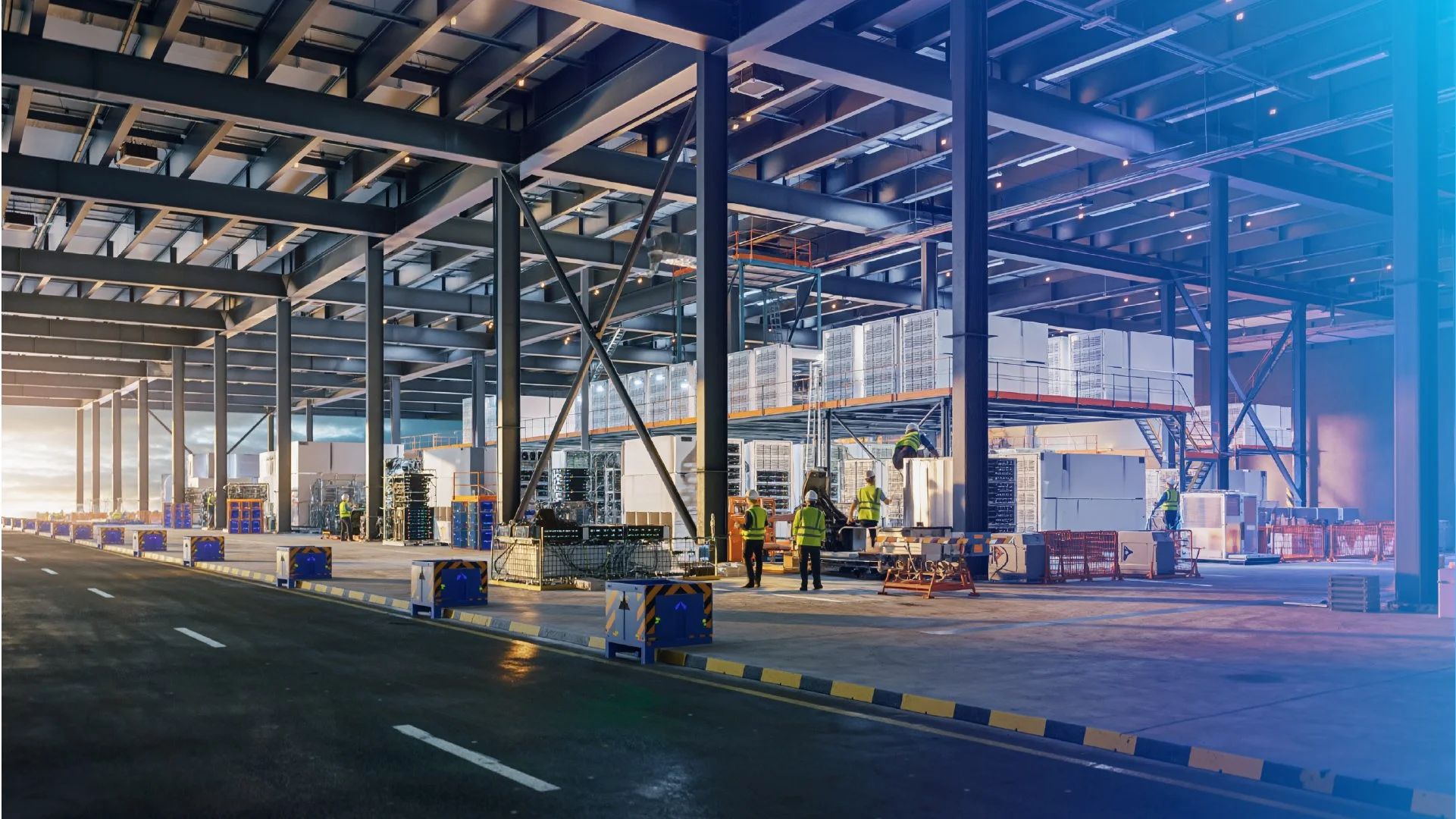
There’s something awe-inspiring about a 500 MW data center. Until you remember how long it takes to build. The tech that goes in often changes faster than the permits clear. And by the time power comes online? The workloads it was designed for may be obsolete.
That’s the hyperscale dilemma: chasing AI growth with industrial-age momentum.
QumulusAI is built to move differently.
Forget Massive. Think Modular.
While the industry celebrates ever-larger campuses, we’re focused on sub-50 MW facilities deployed where they’re actually needed. These aren’t proof-of-concepts or pop-up sheds—they’re fully redundant, GPU-optimized data centers, designed from day one for AI performance and next-gen cooling.
By staying under the 50 MW threshold, we avoid years-long approval cycles. We co-locate with gas and fiber. And we activate faster than most teams can even negotiate a hyperscale contract.
The Cost of Overbuilding
What’s often left out of hyperscale headlines is the cost—not just in dollars, but in friction:
Communities face rising opposition: noise, water consumption, and grid strain have turned public sentiment.
Companies face lock-in: rigid contracts for compute that may no longer serve their evolving models.
And regulators are playing catch-up with energy realities that hyperscalers helped create.
Meanwhile, investors wait. Clients stall. Innovation slows.
AI Moves Fast. So Should Infrastructure.
We’re not anti-scale. We’re anti-lag.
QumulusAI is proving that scale doesn’t have to mean sprawl. By deploying purpose-built facilities faster, closer to where the demand lives, we give our clients access to compute without the drag. No twelve-month waitlist. No fifteen-year amortization gamble.
Just energy-efficient, AI-tuned, revenue-generating infrastructure—in months, not years.
From Molecules to Models
Our approach is vertically integrated: power gen, data center, compute. That means fewer intermediaries, more predictability, and complete control across the stack. It also means we can pass savings to clients and reinvest faster in the tech that matters.
This isn’t just about facilities. It’s about philosophy. QumulusAI believes infrastructure should evolve at the pace of innovation—not slow it down.

Public Backlash Against Data Centers Is Emerging. Here’s Our Plan.

Public pushback against data centers is rising—and not without reason. When massive mega and giga factories threaten to overwhelm local grids, or quietly shift infrastructure costs onto ratepayers, communities are right to demand better.
In New Jersey, electric rates jumped 20%, and lawmakers say hyperscale data centers are overloading infrastructure without covering the costs. NJ101.5
In Pennsylvania, grid operators say surging AI and data center demand is tipping the balance—leaving power supplies potentially short under extreme summer conditions. WESA
In Illinois, new legislation would require data centers to report energy and water use—aiming to uncover whether residents are unknowingly footing the bill for AI growth. Capitol News Illinois
QumulusAI: Built for the Long Term
At QumulusAI, we’re building for the long term: a more strategic, more nimble, and more measured approach to AI infrastructure. Our plans align with local capacity, not against it, and sustain real growth.
Right-sized for the region, not oversized for the headline: We build nimble, sub-50MW facilities designed to match local capacity—not overwhelm it.
Built with diverse, sustainable power—including behind-the-meter natural gas: Our model reduces grid stress, improves resiliency, and aligns with long-term environmental planning.
Live in months, not years: Our modular data centers deploy fast—without dragging down utilities or forcing costly upgrades on ratepayers.
In step with the communities we serve: We work directly with policymakers, utilities, and local leaders to align infrastructure growth with public interest—not just private demand.
Sustainable by design: Our energy-efficient clusters are optimized for AI workloads from day one—minimizing waste, maximizing performance, and staying accountable to the regions that host us.
The data center industry is at a crossroads. We can keep bulldozing through communities with oversized projects that privatize profits and socialize costs—or we can prove that AI infrastructure can actually strengthen the places that host it. The choice we make now will determine whether communities welcome the next wave of technology or fight it at every turn.